THERMINATOR Stakeholder spotlight – Today with ENDEF
Who are the THERMINATOR partners driving innovation in waste heat recovery and next-generation energy conversion across Europe?
Our Partner Interview Series highlights the leading organisations in the THERMINATOR consortium, showcasing their expertise, contributions, and key roles in the project.
Each partner also shares its vision of how THERMINATOR contributes to Europe’s energy transition and the European Green Deal objectives—by advancing innovative waste heat recovery technologies and developing a novel thermoacoustic and electrocaloric energy conversion “skin” to improve energy efficiency and reduce emissions.
 Discover our latest interview to learn more about ENDEF and its impact!
Briefly introduce your organisation
ENDEF is an SME based in Zaragoza (Spain) who works as a world reference in hybrid solar technology. Orchestrated by different research lines, our team works on the continuous improvement and adaptation of the latest technologies.
ENDEF is able to manufacture all kinds of solar hybrid panels due to our experience within the field. We develop new models of hybrid panels, from design to manufacturing and count on several, fully-monitored testing benches with real-time data acquisition to experimentally assess the performance of photovoltaic, thermal and solar hybrid panels. Thanks to this equipment, we can obtain and evaluate key technical features, such as energy efficiencies or thermal performance parameters.
Introduce the team working on THERMINATOR within your organisation

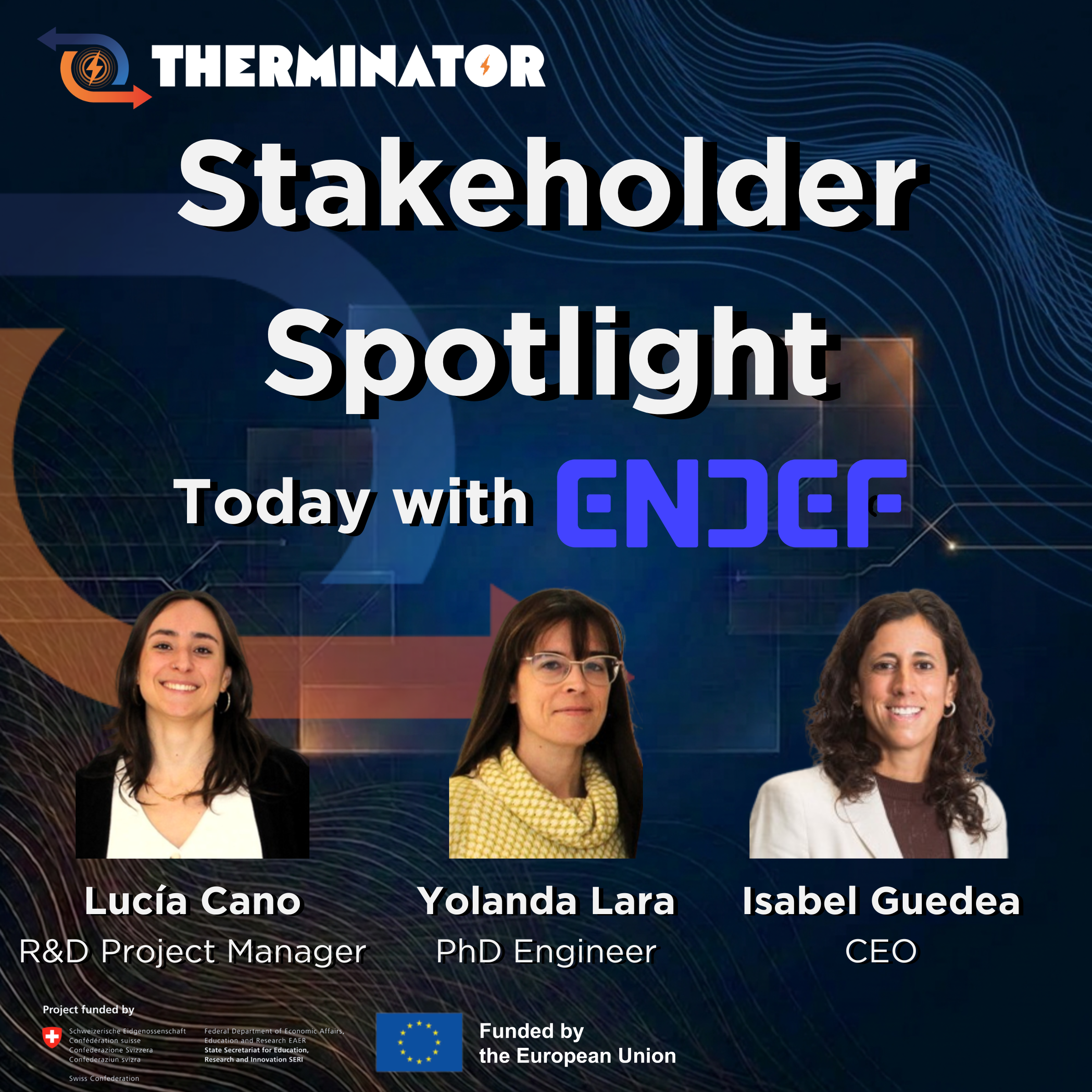
Lucía Cano: Bachelor’s and Master’s Degree in Chemical Engineering. Her work focuses on applied research in solar energy technologies, including the development of hybrid photovoltaic-thermal (PVT) systems, PV module temperature monitoring, system integration and numerical modelling of solar energy systems at ENDEF. She has participated in three international and two national R&D&I projects and has presented results at international conferences.

Yolanda Lara: PhD in renewable energies and energy efficiency and Industrial engineer. She has participated in 17 national and international research projects, coordinating four of them. She is co-author of 28 scientific articles in JCR journals (h-index=16) and has participated in 19 international conferences and workshops. She is currently responsible for R&D at ENDEF, developing and promoting several solar applications such as photovoltaic integration, monitoring and hybrid solar panel integration.

Isabel Guedea: ENDEF’s CEO and co-founder since 2012; PhD in renewable energies and energy efficiency and Chemical engineer, with previous experience in oxi-combustion processes, fluidized bed design and modelling, and process control and automation. Extensive experience in project management, solar energy, both photovoltaic and thermal, as well as in PVT design, development and manufacturing. Solar energy advocate, she also has a prominent role in different solar associations, being the first woman directing Solartys (a spanish solar energy cluster), and belonging to Clenar’s (Aragón energy cluster) board of directors.
What is your organisation’s role in the project? What unique contribution does it bring to THERMINATOR?
ENDEF is responsible for the numerical model of a photovoltaic laminate to reproduce the heat generated in the PV cell, and thus, evaluate the potential of the integration of THERMINATOR technology to solar industry.
ENDEF, as expert on solar panels, will provide the project with knowledge on this field, as well as strategies to integrate the THERMINATOR technology within solar energy.
To what extent do you think THERMINATOR will contribute to improving energy efficiency and supporting Europe’s transition towards climate neutrality?
The technology combination approached in THERMINATOR may allow the use of different systems as low-temperature heat sources for the newly developed technology, also opening new paths for targeted cooling or energy generation. Working on new energy recovery routes directly supports Europe’s fossil-fuel reduction goal.
In your opinion, what role will advanced thermal energy conversion technologies play in shaping more sustainable and energy-efficient industries, buildings, and transport systems in Europe?
The advanced thermal energy conversion technologies being developed in THERMINATOR can be used for both, localised cooling or energy generation at different places, and shaped in order to take the most advantage of the used source. There is a whole range of possibilities waiting for this technology to ramp up.