THERMINATOR Stakeholder spotlight – Today with Brunel University London
Who are the THERMINATOR partners driving innovation in waste heat recovery and next-generation energy conversion across Europe?
Our Partner Interview Series highlights the leading organisations in the THERMINATOR consortium, showcasing their expertise, contributions, and key roles in the project.
Each partner also shares its vision of how THERMINATOR contributes to Europe’s energy transition and the European Green Deal objectives—by advancing innovative waste heat recovery technologies and developing a novel thermoacoustic and electrocaloric energy conversion “skin” to improve energy efficiency and reduce emissions.
 Discover our latest interview to learn more about Brunel University London and its impact!
Briefly introduce your organisation
Brunel University London (BUL) participates through the Brunel Innovation Centre (BIC), a premier research department dedicated to transferring cutting-edge academic research into commercial applications. BIC specialises in artificial intelligence, machine learning, ultrasound engineering, and advanced electronic systems. With access to extreme-performance computing servers for finite element analysis and deep learning, BIC has a strong track record of developing smart, autonomous systems. Our mission within international consortia is to bridge the gap between fundamental science and functional, market-ready prototypes, driving technological innovation to solve critical real-world industrial challenges.
Introduce the team working on THERMINATOR within your organisation
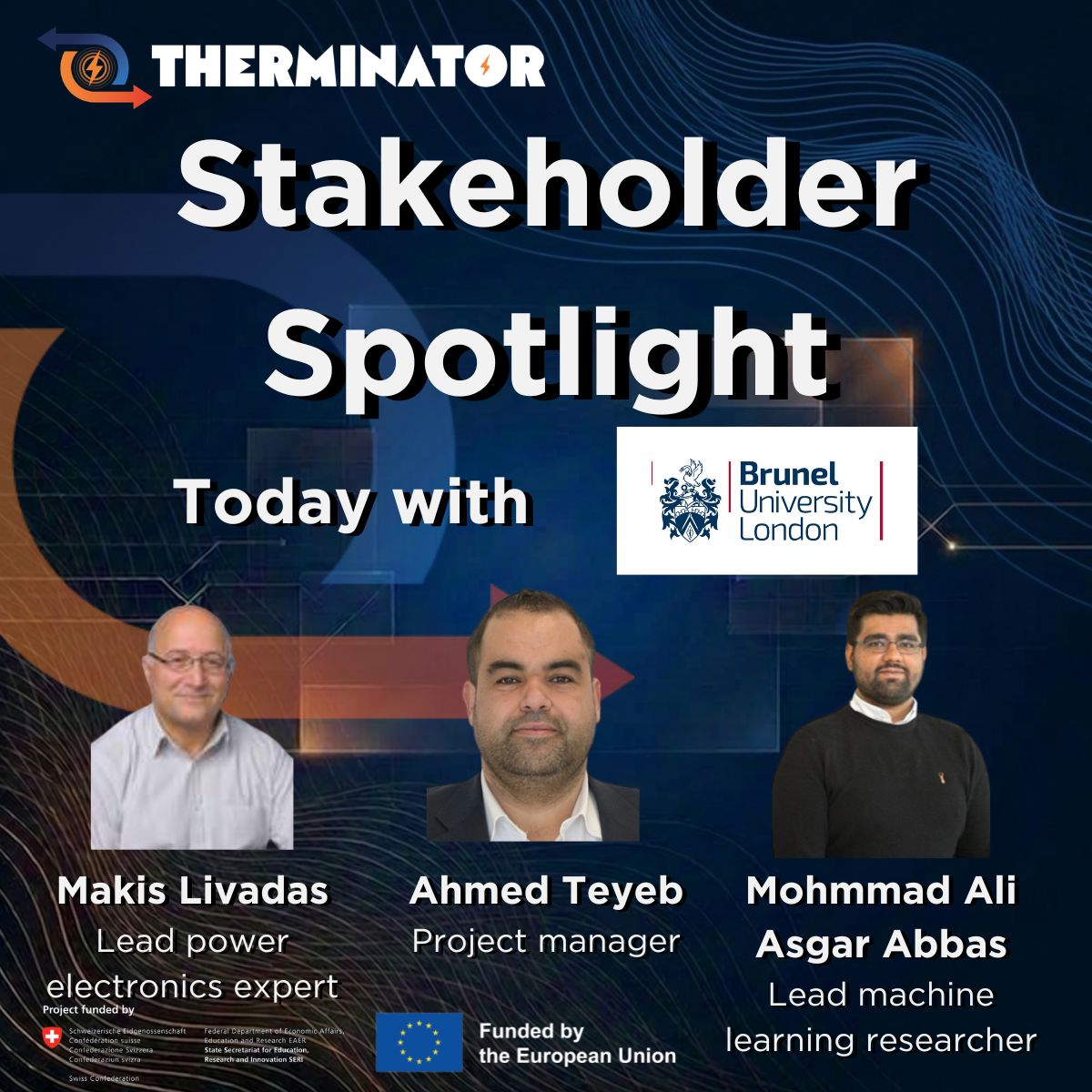
 Dr. Makis Livadas is our lead power electronics expert; he spearheads the design of complex high-voltage circuits, intricate Altium PCB layouts, and the physical realisation of the Olsen Cycle Harvester prototype.
 Dr. Ahmed Teyeb leads our internal project management, ensuring seamless coordination while also assisting with critical electronics testing and integration tasks.

Mr Mohmmad Ali Asgar Abbas is our lead machine learning researcher. He drives the innovative SCOUT AI optimisation framework, utilising advanced Bayesian Optimisation algorithms to dramatically accelerate real-time system performance evaluations and surrogate modelling.
What is your organisation’s role in the project? What unique contribution does it bring to THERMINATOR?
BUL leads Work Package 4, “Smart Controls and Integration”. Our unique contribution lies in providing the intelligent electronic backbone for the THERMINATOR system. We are designing the power electronics to drive both the electro-caloric and thermo-acoustic sub-systems. Furthermore, we are developing the SCOUT framework, an AI-driven machine-learning system utilising Bayesian Optimisation. This smart control architecture enables real-time optimisation and autonomous synchronisation of the hybrid energy harvesting platform. By applying deep neural networks to evaluate performance in under 10 milliseconds, we ensure physical prototypes operate at maximum efficiency
To what extent do you think THERMINATOR will contribute to improving energy efficiency and supporting Europe’s transition towards climate neutrality?
THERMINATOR offers a revolutionary approach to harvesting low-grade waste heat. By combining electro-caloric and thermo-acoustic technologies with BUL’s smart AI controls, the system can maximise electrical energy recovery from heat sources below 100°C. This will significantly reduce the primary energy consumption of heat networks, industrial processes, and solar installations. BUL’s ultra-fast surrogate models and optimisation algorithms ensure the system adapts instantly to environmental changes, operating continuously at peak efficiency. This intelligent, solid-state energy recovery directly accelerates Europe’s transition to climate neutrality by reducing greenhouse gas emissions from fossil-fuel-based power generation.
In your opinion, what role will advanced thermal energy conversion technologies play in shaping more sustainable and energy-efficient industries, buildings, and transport systems in Europe?
Advanced thermal energy conversion technologies are critical for creating truly circular and sustainable European industries. Traditional systems rely on mechanical compressors and hazardous refrigerants that harm the environment. Emerging solid-state technologies, like the hybrid electro-thermal “skin” developed in THERMINATOR, eliminate these toxic components while offering unprecedented scalability and adaptability. In buildings, they can act as active thermal insulation; in transport, they enable efficient thermal management of structural batteries. Coupled with digital smart controls, these advanced technologies will transform passive infrastructure into active, self-optimising ecosystems that minimise energy waste across all sectors.