New THERMINATOR publication explores the potential of heat recovery in food refrigeration systems
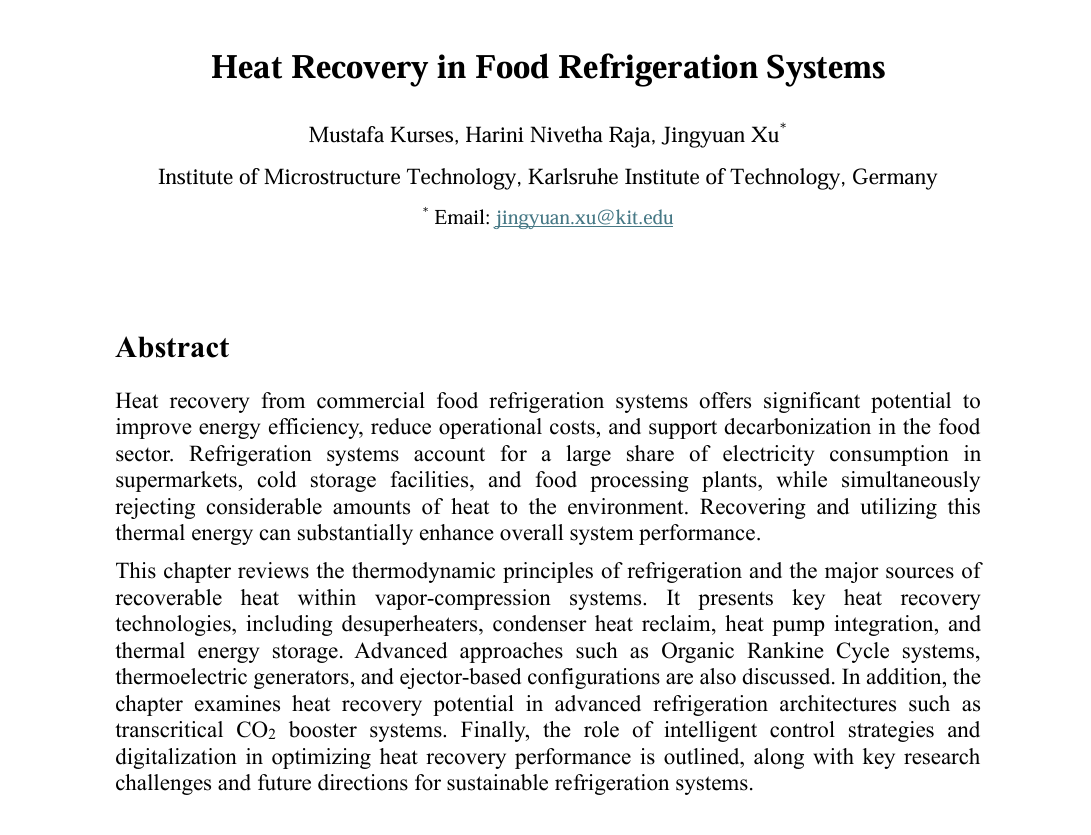
How can the food sector make better use of the heat generated by refrigeration systems? A new chapter published online by Elsevier examines the technologies, applications and future opportunities for recovering and reusing this thermal energy.
The chapter, “Heat Recovery in Food Refrigeration Systems”, has been authored by Mustafa Kurses, Harini Nivetha Raja and Jingyuan Xu from the Institute of Microstructure Technology, Karlsruhe Institute of Technology (KIT), Germany.
Published online by Elsevier as part of the Reference Collection in Food Sciences, the chapter will also be included in the forthcoming Comprehensive Food Refrigeration, scheduled for publication in January 2027.
Turning rejected heat into a useful energy resource
Refrigeration is essential across the food supply chain, from processing and storage to transport and retail. However, refrigeration systems are also significant energy consumers. At the same time, the operation of a refrigeration system inevitably produces heat that is normally rejected to the surrounding environment.
The new chapter examines how this rejected thermal energy can instead be recovered and put to productive use.
In a conventional vapour-compression refrigeration cycle, the condenser is the main location for heat rejection and therefore represents a major opportunity for heat recovery. The chapter explains that the heat rejected by the condenser combines the cooling load extracted from the refrigerated space with the energy supplied to the compressor. This makes refrigeration systems a potentially significant source of recoverable thermal energy.
Recovered heat can be used for a range of applications, including space heating, domestic hot water production, process water preheating and industrial process heating.
From direct heat recovery to advanced system integration
The chapter provides a comprehensive overview of the technologies available to recover and make use of this energy.
Among the approaches discussed are desuperheaters, which recover high-temperature heat from refrigerant leaving the compressor, and condenser heat recovery, which can provide larger quantities of moderate-temperature heat.
The authors also examine the integration of heat pumps and thermal energy storage. Heat pumps can upgrade low- and medium-temperature waste heat to levels suitable for hot water production or industrial processes, while thermal storage can help address the mismatch between when heat is available and when it is needed.
The review further explores more advanced solutions, including Organic Rankine Cycle systems, thermoelectric generators, ejector-based configurations and transcritical CO₂ refrigeration systems.
Matching heat supply with demand
One of the key messages of the chapter is that heat recovery is not simply a question of how much heat is available.
The temperature level, quantity of heat and timing of supply and demand all need to be considered when designing an effective recovery system. For example, the high-temperature heat available during refrigerant desuperheating is particularly suitable for applications requiring higher temperatures, while the larger quantity of heat released during condensation can be used for moderate-temperature applications.
This makes system integration and intelligent control particularly important. The chapter highlights how thermal storage, heat pumps and digital control strategies can help optimise the use of recovered heat and adapt system operation to changing demand.
A contribution to more sustainable food refrigeration
Beyond the technical opportunities, the chapter identifies several challenges that currently limit the widespread adoption of heat recovery, including system complexity, upfront investment costs and knowledge gaps in industry practice.
The authors therefore point towards future research focusing on system-level integration, scalable and cost-effective solutions, and robust control strategies capable of operating reliably under real-world conditions.
The combination of advanced refrigeration technologies, thermal storage and digital optimisation could ultimately help transform refrigeration systems into multifunctional energy hubs, contributing to more sustainable and resilient energy systems.
An outcome of the THERMINATOR project
This publication is an outcome of the THERMINATOR research project, supported by the European Union’s Horizon Europe Research and Innovation Programme.
Through research and innovation in thermal management and refrigeration technologies, THERMINATOR contributes to the development of solutions that can improve energy efficiency and support the transition towards more sustainable food systems.
📖 Publication: Heat Recovery in Food Refrigeration Systems
Authors: Mustafa Kurses, Harini Nivetha Raja, Jingyuan Xu
Institution: Institute of Microstructure Technology, Karlsruhe Institute of Technology (KIT), Germany
Publisher: Elsevier
Collection: Reference Collection in Food Sciences
Forthcoming book: Comprehensive Food Refrigeration (January 2027)