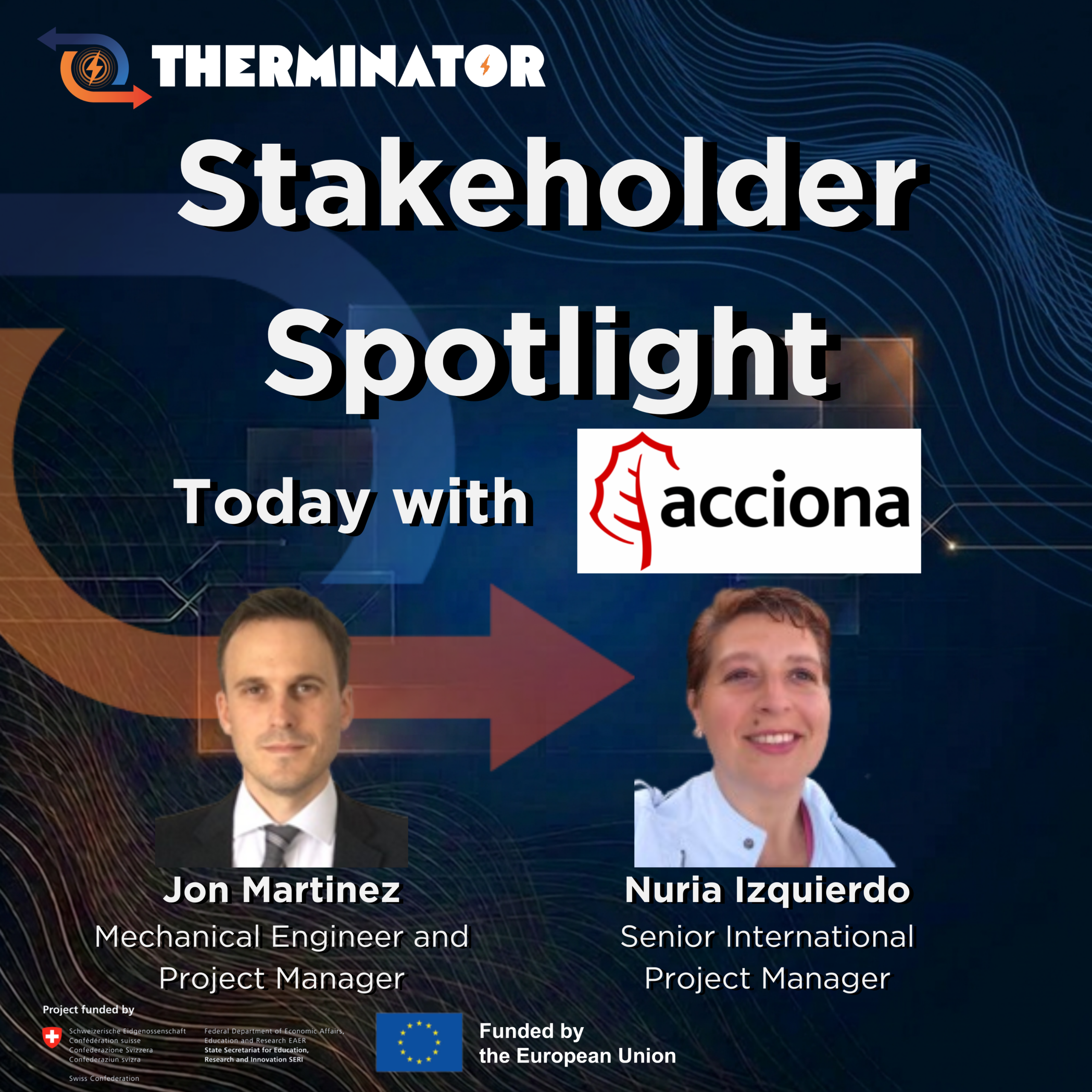
THERMINATOR Stakeholder spotlight – Today with ACCIONA
Who are the THERMINATOR partners driving innovation in waste heat recovery and next-generation energy conversion across Europe?
Our Partner Interview Series highlights the leading organisations in the THERMINATOR consortium, showcasing their expertise, contributions, and key roles in the project.
Each partner also shares its vision of how THERMINATOR contributes to Europe’s energy transition and the European Green Deal objectives—by advancing innovative waste heat recovery technologies and developing a novel thermoacoustic and electrocaloric energy conversion “skin” to improve energy efficiency and reduce emissions.
 Discover our latest interview to learn more about ACCIONA and its impact!
Briefly introduce your organisation
ACCIONA Engineering is a leader with over 50 years of experience in the industrial, civil, and environmental sectors. Supported by a multidisciplinary team of 350 professionals, the firm utilizes state-of-the-art technology to handle any civil or industrial infrastructure, architecture, or urban development project, always with an emphasis on environmental issues and energy efficiency. With a strong international focus, the company has operated in 70 countries across five continents over the last five years, managing projects from its Madrid headquarters and global branches in Australia, Latam, Africa, Eastern Europe, and MENA, covering every stage from planning to supervision.
Introduce the team working on THERMINATOR within your organisation
 Jon Martínez is a mechanical engineer and Project Manager specializing in renewable energy, green hydrogen, and district heating and cooling. With extensive consultancy experience, he leads multidisciplinary teams and complex technical projects, delivering innovative industrial and energy-efficient solutions.
 Nuria Izquierdo is a Senior International Project Manager at ACCIONA with 29 years of experience. A specialist in European grants and international tenders, she excels at leading multidisciplinary teams and managing complex global development projects.
What is your organisation’s role in the project? What unique contribution does it bring to THERMINATOR?
ACCIONA leads the validation of the THERMINATOR solution through a specific use case: thermal networks. As specialists in District Heating and Cooling (DHC) systems, we provide the essential operational parameters and technical requirements derived from our real-world infrastructure experience. By performing advanced simulations and defining precise environmental constraints, we assess the device’s viability to ensure its technical design aligns with real-world operating conditions. Our contribution is key to evaluating how this technology can improve energy efficiency and unlock new capabilities within our existing DHC network.
To what extent do you think THERMINATOR will contribute to improving energy efficiency and supporting Europe’s transition towards climate neutrality?
THERMINATOR significantly boosts energy efficiency by harnessing the thermal gradient between heating pipes and the ground to convert waste heat into electricity. This autonomous system will power low-consumption sensors, replacing disposable batteries and avoiding the technical failures and voltage drops associated with traditional long-distance cabling. By eliminating monitoring “blind spots” in district heating networks, it allows for precise, real-time management of energy resources. This innovation supports Europe’s climate goals by fostering a circular economy where infrastructure uses its own waste heat for self-optimization, ensuring a resilient, maintenance-free, and battery-free monitoring network.
In your opinion, what role will advanced thermal energy conversion technologies play in shaping more sustainable and energy-efficient industries, buildings, and transport systems in Europe?
These technologies will be fundamental in transforming European urban areas into ‘proactive’ Smart Cities. Focusing specifically on district networks, they enable self-diagnosing infrastructure, allowing for the detection of micro-leaks or anomalies weeks before they become critical, which reduces disruptive street works and improves traffic flow. Furthermore, they eliminate energy ‘blind spots,’ allowing heating networks to be optimized street-by-street based on real-time demand. These solutions also promote true sustainability by removing millions of disposable chemical batteries from underground systems and enhance urban resilience, as sensors remain operational independently of the main power grid, ensuring critical data flow during emergencies.